When I got to work on Tuesday—my first day since Anne Carson had won the Nobel Peace prize in literature—I had a feeling that Natalie, who loves Carson, would have many thoughts. She also had many books. And the keys to a display case. She asked me if I’d be interested in working on an exhibit of Carson’s work, of which the Rare Book Room had only one book, but the circulating collection and Natalie’s personal library pretty much had the rest. I couldn’t say no.
Anne Carson is a Canadian writer, scholar, and translator best known for her experimental blend of poetry and prose influenced by classical literature. She also holds a PhD in classical literature from the University of Toronto. In 2001, she was the first woman to win the T. S. Eliot prize, and was also awarded a Guggenheim Fellowship for Poetry in 1998 and a MacArthur fellowship in 2000. She has taken classics—a discipline considered by many to be pretentious, long obsolete, and inaccessible to anybody without a degree in it—and made it fresh, new, and accessible by highlighting female voices and queer stories and putting these timeless ideas into a more modern style and register.
Anne Carson represents everything that I, as a classics and creative writing major, aspiring translator, and lover of literature, want to be for the ancient writers of Greece and Rome. That’s why I couldn’t say no to working on the exhibit. That, and because Natalie is my boss.
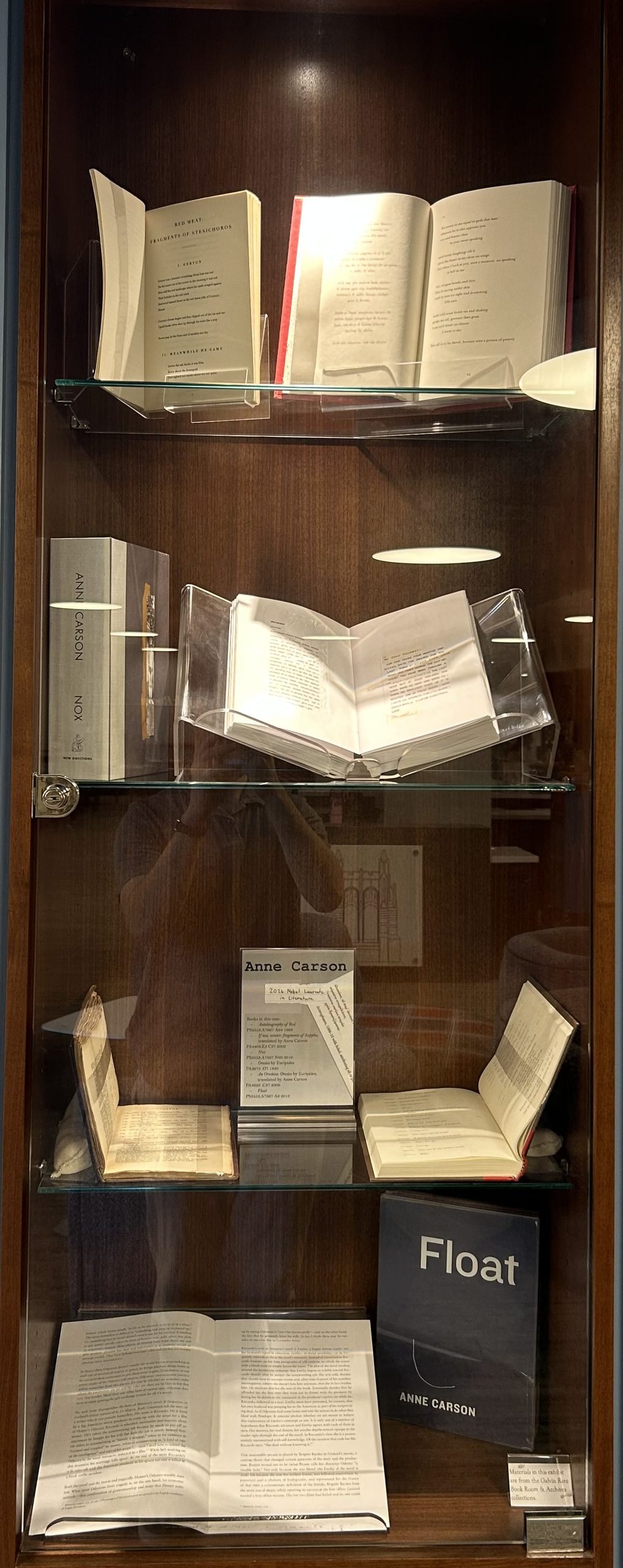
Carson, being known for the erudite and experimental, can be difficult to present based on snapshots alone, so I had to choose carefully. While I wanted to highlight what it is that makes her work exceptional and unique, I also wanted to share projects that wouldn’t take graduate level knowledge of classical philology to appreciate. I tried to create a collection that demonstrated the breadth of her range. Working from the top of the exhibit down, the beginning of Autobiography of Red, her best-known book, is an incredible hook, so I let it be exactly that. Next, we have the most popular Sappho fragment 31, oft translated by everyone from Roman poet Catullus around 50 BCE to my creative writing course last week. Nox is a great example of her experimental style, both in style and in medium. I wanted to show the scrapbook format, which contains philological analysis of other poetry and of her own grief. Next was An Oresteia, not a translation of Aeschylus’ trilogy, but rather a trilogy of her own, spanning the great Greek tragedians: Aeschylus, Sophocles, and Euripides, who tell their own versions of the same tragic cycle. Anybody who has spent any time on Pinterest has seen the quote:
Plyades: I’ll take care of you.
Orestes: It’s rotten work.
Plyades: Not to me. Not if it’s you.
This is from Carson’s translation of Euripides’ Orestes and is what I chose as the focal point of the exhibit, alongside an 1830 text and commentary of the same passage from the Rare Book Room. Finally, her unusual chapbook collection, Float, which I’m still kicking myself for not buying a copy of at an English book store in Rome. The specific page on display includes the quote: “His name is Riccardo. He is hired by a big American movie producer to come up with the script for a film of Homer’s Odyssey.” I can’t really explain this one. Something about it just seemed timely.
What better way to honor the newest Nobel laureate, whose work has taken great strides in making classical literature fresh and alive again, than by displaying her work right beside the ancient texts on which she has left an indelible impact?