The Books Behind ‘Barbenheimer’

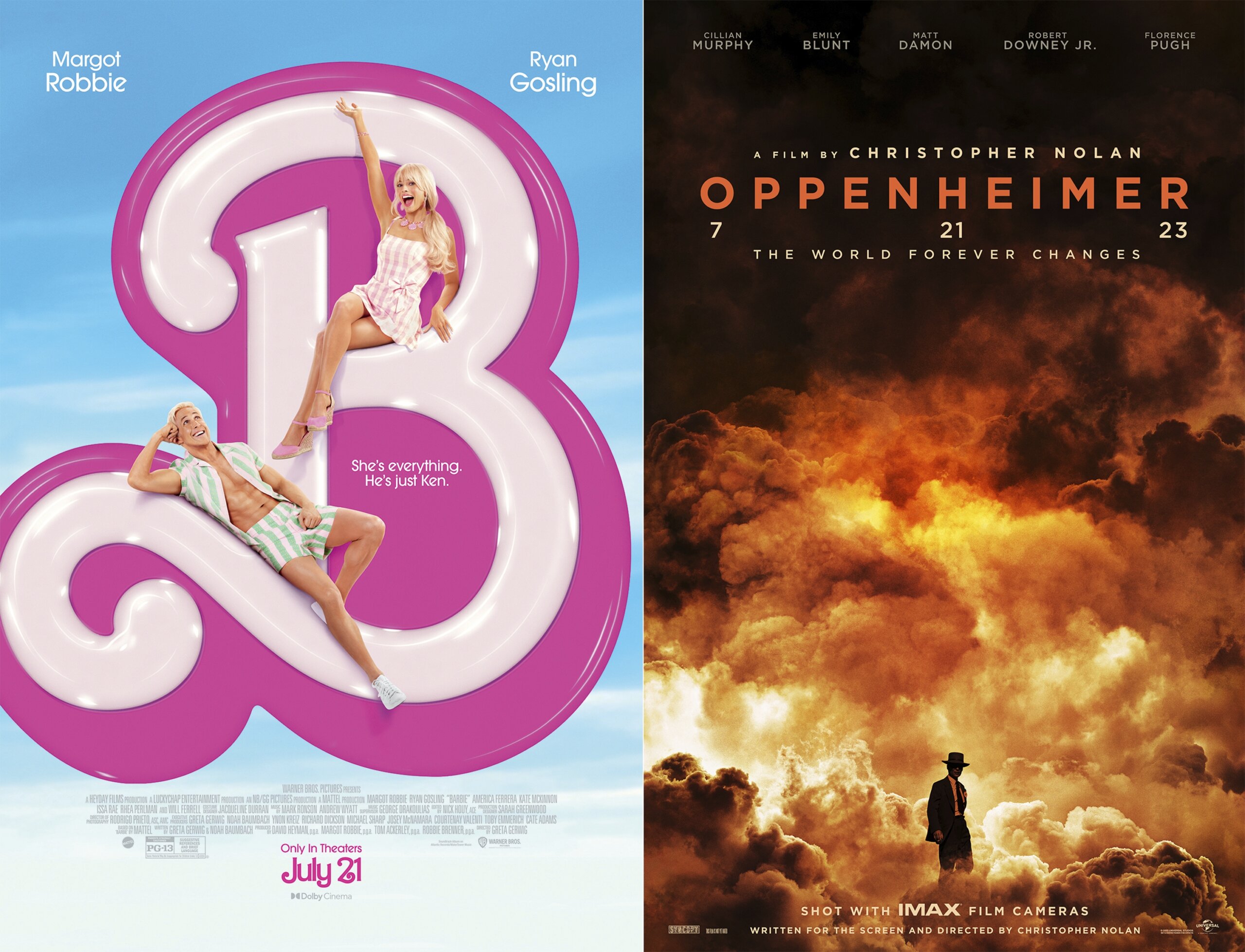
This summer gave way to the cultural phenomenon that was ‘Barbenheimer,’ which can be best described as the seemingly bizarre comparison between two feature films, Barbie and Oppenheimer. Both of these films were released on the same day in July, and many expected them to be the two best films of 2023. On the surface, Barbie and Oppenheimer could not be more different from one another, Barbie being a comedic film about children’s toys finding a way to enter the real world and Oppenheimer being a drama about the man behind the creation of the atomic bomb. When creating this exhibit, we wanted to find common ground between these two films through textual evidence within our collection here in the University of Richmond’s Galvin Rare Books Room and show that perhaps within the American experience, ‘Barbenheimer’ is not such a bizarre concept. 

When selecting books for the Barbie portion of the exhibit, we aimed to have a blend of Mattel produced items as well as philosophical discussions on how Barbie has affected society and where exactly the toy originated from. Our 1964 edition of Barbie’s Easy as Pie Cookbook published by Mattel is without a doubt a gem of this exhibit. In addition to the cookbook and a Barbie doll herself, we’ve featured two more modern books that go further into detail on not only who created Barbie, in Barbie and Ruth, but also how the concept of Barbie as an ideal woman with the power to pursue anything she dreamed might have consequences on our society, in The Good, the Bad, and the Barbie. These three books offer a glimpse into the philosophy behind Barbie directed by Greta Gerwig and starring Margot Robbie as Barbie and Ryan Gosling as Ken. The film is very introspective despite being a comedy, and it shows how Mattel has constructed a seemingly perfect image of Barbie that might unintentionally strike questions of living a purposeful life and dealing with the consequences of having human flaws. Mattel’s Barbie’s Easy as Pie Cookbook falls in line with this image of easy-going perfection, and our other two book selections begin to peel back the curtain in many of the same ways that Gerwig’s film does.

The Galvin Rare Books room did have quite a few illuminating works when we began to put together the Oppenheimer portion of the exhibit. The film, directed by Christopher Nolan and starring Cillian Murphy, highlights the life of Dr. Robert J. Oppenheimer and his work on the Manhattan Project, which produced the uranium and plutonium atomic bombs. It also showcases the aftermath of the project and how Dr. Oppenheimer went on to push against the production of the hydrogen bombs, expressing concern for the morality of killing hundreds of thousands of people once again. We wanted to not only feature Dr. Oppenheimer’s work, but to showcase the lasting effects of the Manhattan Project and American perspectives on nuclear warfare. The two books that are particularly fascinating are Nobody Wants A Nuclear War and Hearings Regarding Communist Infiltration of Radiation Laboratory and Atomic Bomb Project at UC Berkley. Nobody Wants A Nuclear War is a children’s picture book written in 1986 describing how frightened children were that because of the constant threats between the United States and the USSR, another atomic bomb would be dropped. Instead of the war being on foreign ground, the children were scared it would be where they lived. This book is particularly striking in relation to the mental consequences that nuclear warfare had on generations to come, even forty years after the atomic bombs were dropped on Nagasaki and Hiroshima, and it shows how the effects of war become more real when they threaten you instead of your enemy. The second work is the transcript of hearings in which a government appointed investigation interviews many important figures who worked on the atomic bomb projects throughout World War II, including General Groves who spearheaded the military portion of the project as well as Dr. Frank Oppenheimer, Dr. Robert J. Oppenheimer’s brother. The interviews were conducted in order to investigate who leaked top-secret information to the USSR or to communist parties within the United States. These two rare items in our collection highlight the long-lasting effects of nuclear warfare in the mind of Americans, and they express a feeling of mistrust and doubt over the decisions that the government had made in the past.

The Barbenheimer exhibit aims to foster thorough questioning of the American experience in many of the same ways that Barbie and Oppenheimer aim to do as well. As you peruse the exhibit, consider whether or not these films and books of the cultural phenomenon of ‘Barbenheimer’ seem all that different. In both of our Barbie and Oppenheimer themes, it is clear that an existential doubt emerges: what is the purpose of consumption and creation? What consequences do my actions and my life bring? If I aim to bring good to the world, will good come after me? 

List of items displayed:

  • Barbie’s Easy as Pie Cookbook PZ10.L39 Ba 1964
  • The Good, the Bad, and the Barbie NK4894.3.B37 S76 2010
  • Barbie and Ruth NK4894.2.H324 G47 2009
  • Robert Oppenheimer QC16 .O62 M66 2013
  • Hearings Regarding Shipment of Atomic Material to the Soviet Union during World War II E743.5 .U4 1950 
  • Nobody Wants a Nuclear War PZ7.V67 No 1986 p. “Sometimes i’m scared”
  • Three Poems for Now PS3523.I648 T4 1972 
  • Hearings Regarding Communist Infiltration of Radiation Laboratory and Atomic Bomb Project at UC Berkeley E743.5 .U64 1949 
  • Three Lectures on Atomic Physics QC173 .S53 1926
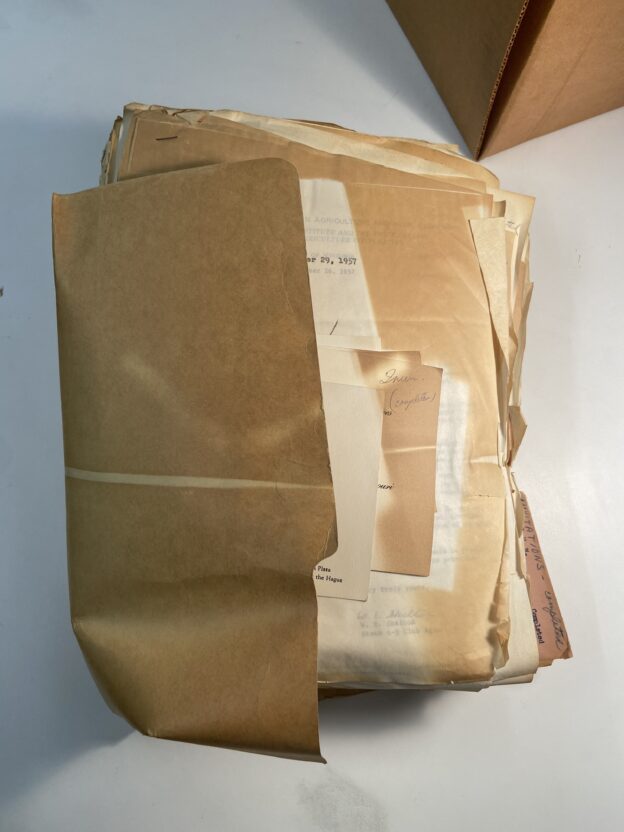
Overstuffed file folder containing discolored pages.

Walk You Through The Process

When I tell people my job title, Processing & Reference Archivist, there is always a little pause as they try to figure out what that means. I usually quickly follow up with, “What does that mean?” and give a quick explanation of Reference Archivist and Processing Archivist. The Reference part most people get; it’s the Processing part that most people don’t.

Processing a collection basically means making it usable and discoverable by researchers. There are a variety of actions a collection may or may not require, depending on what state it’s in when we acquire it. One of the basic preservation tasks I undertake is called re-housing. I remove documents from their original folder and place them in a new, archival folder. I transcribe any original information recorded on the old folder onto the new folder, in addition to any information required to identify the folder in our collection.

So, yes, I get paid to move papers from one folder to another. The photo I’ve included helps illustrate why I do that. This badly over-stuffed folder had been sitting in its records carton for about 60 years. It was the first folder in line so had been pressed up against the inside of the box. The “tan lines” on the visible pages demonstrate why archival folders and boxes are different from regular everyday folders and boxes. The folder had protected part of the pages from the surface of the box. Archival folders and boxes are engineered to be free of the acids and lignins that naturally occur in most paper products. You can also see where a rubber band had valiantly tried to hold it together before degrading. Pro tip: do not use a rubber band to hold your documents together. If the rubber band doesn’t tear the edges of the papers, it will inevitably degrade and either stick to whatever surface it’s touching, or come apart just as you’re removing the folder from the box, thereby spilling the papers onto the table, the floor and just all over the place.

I re-housed this beast into five archival folders. As part of that work, I smoothed out any wrinkles and creases, unfolded folded-up documents, removed paperclips (they rust and tear paper), and placed barriers between newspaper or telegrams and adjoining documents. Newspaper, telegrams and similar materials were not intended to last long. They’re cheap, mass-produced materials which quickly degrade and will stain, and weaken, whatever papers they’re filed against because they are not, you guessed it, acid-free or lignin-free.

If you have newspaper clippings stored somewhere at home, don’t expect them to last forever unless you put in a little preservation effort. If it’s just the information you want to keep, consider making a photocopy or digital scan. If the clipping or newspaper itself has intrinsic value, there are polypropylene sleeves of various sizes available from reputable archival supply companies. It’s best to store the newspaper as flat and unfolded as possible. The paper becomes brittle as it degrades, so if you have a clipping folded up in an envelope, be prepared for that envelope to eventually contain newspaper confetti.

If I didn’t take any of these actions, the researchers would be left digging through all the boxes (and for this collection, that’s around 300 records cartons). More likely, I would be the one doing the digging. But taking these actions means I can quickly provide the researcher the information they are looking for. Being a Processing Archivist makes my job as a Reference Archivist much easier.

Please Pardon Our Dust…..

Photo of the front of Boatwright Library under construction with dirt hill and machinery.
Construction in front of Boatwright Library Summer 2023 (Photo credit: Travis Smith)

If you have driven by Boatwright Library recently, you will have seen the large construction areas surrounding parts of the library. This summer, work started on an 18-month project that will bring beautiful new spaces and exciting things to this campus landmark.

During this time, the library is open and available to students, faculty, staff and community members as usual. Our department — Book Arts, Archives, and Rare Books — is right in the middle of the construction zone, so it requires some changes to our availability. While under construction, we will be able to continue to assist researchers by appointment only. Our resources are available for your research or class assignments, and our staff is available to assist you with book arts, rare book, or archival projects.

The best way to contact us during this time is via email: archives@richmond.edu for rare books and archival assistance and bookarts@richmond.edu for assistance with book arts projects or instruction.

We appreciate your patience during the project and look forward to enjoying these new spaces in the future!

Collection Spotlight: MS-41 The Earl & Jewell Ratliff Collection

Note: This post was written by Savannah Etzler as part of her internship through Simmons University with Book Arts, Archives, & Rare Books in Boatwright Library. Savannah also processed the Ratliff collection and curated an exhibit about the collection’s football ephemera.

The Earl and Jewell Ratliff Collection contains University of Richmond memorabilia, service awards, ephemera, photographs, and postcards representing the life of Earl and Jewell Ratliff and their support of the University of Richmond, volunteer organizations, and their passion for travel. On April 10, 1926, Earl was born in McComb, Mississippi, and in 1944 he received his high school diploma from Woodrow Wilson High School in Portsmouth, Virginia. Following his service in the Army, Earl and Jewell were married in Newport News, Virginia on March 24, 1951, the same spring that Earl graduated from the University of Richmond with a Bachelor of Science in Business Administration. Jewell was born on September 7, 1929 in Jacksonville, Florida and graduated from Woodrow Wilson High School in 1946 before beginning work at the C&P Telephone Company, where she would work for over 36 years.

Earl was a guard for the University of Richmond football team in 1949 and was known as one of the ‘Portsmouth Boys,’ a group of students hailing from the nearby city. His participation in Spider athletics is documented in event programs, newspaper clippings, and football rosters that provide valuable insight into the university’s history. Between the 1960’s and the 1990’s, Earl and Jewell continued to support the university’s athletic program, attending many sporting events and amassing a substantial collection of tickets and sideline passes. The couple were also involved in the Spider Club and participated in the Homecoming Action Committee as documented in their collection of university ephemera. These materials are evidence of the legacy of alumnae support that continues to shape the university.

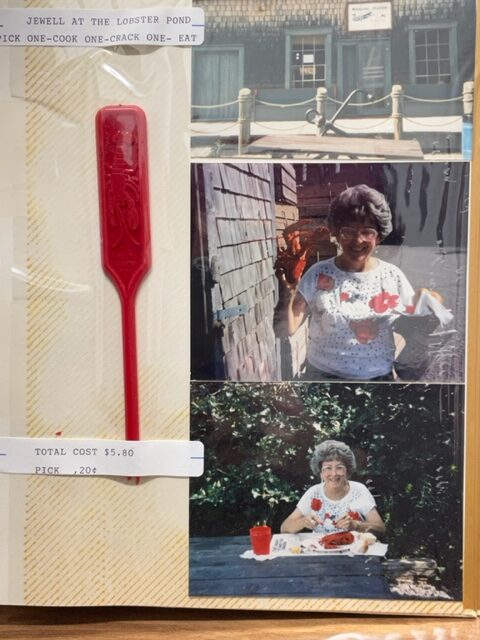
The couple were avid travelers and preserved their memories in the pages of several scrapbooks, which detail their trips across the United States, Mexico, and Canada during the 1990’s. Peppering these pages are labels that identify sites, note travel arrangements, and preserve special memories, and it is here that Earl and Jewell’s personalities and sense of humor shine through the passage of time. The following images reveal the charm of this collection, that of a unique couple who enthusiastically pursued their passions and found joy not only in the natural wonders of the world, but also the whimsy of the mundane. These annotations, whether documenting exceptional meals, amusing signs, or the beauty of the U.S. National Parks, provide an intriguing peek into the experiences of travel enthusiasts during the 90s. Together, Earl and Jewell explored the continent and documented their adventures, leaving behind a valuable collection which allows us to see world through their eyes.

This collection was acquired as part of an estate donation upon Jewell’s passing in 2016. This collection represents the couple’s posthumous support of the University of Richmond and its students.

photo of scrapbook page showing Jewell Ratliff eating a lobster. Her captions read "jewell at the lobster pond, pick one, cook one, crack one, eat" and "total cost $5.80, pick $.20".
One of Jewell Ratliff’s travel scrapbook pages.

Dr. and Mrs. Wyatt Tee Walker Collection Update

Note: This post was authored by Taylor McNeilly, Processing & Reference Archivist.

Welcome back to another #wyattwalkerwednesday! I know it has been a while since I posted any updates about the collection, but I have some big updates today to make up for it. In fact, I have what may be the most significant announcement to date: we are opening a portion of the physical collection for research! But first, some earlier updates about work we have done recently.

Just before and during the pandemic, we have opened up a number of digital portions of the collection. These started with what we call the Birmingham Tapes, recordings of ten mass meetings held during the Birmingham Campaign in 1963. Because these were thought to be the oldest audiovisual material in the collection, they were deemed top priority for digitization, since that process not only allows for easier access via the Internet but also preserves the material in a new, digital format. Magnetic media such as audio cassettes or VHS tapes have an estimated “shelf life” of approximately 40 years, so you can understand the concern we had for recordings that were nearly 60 years old.

After the Birmingham Tapes were digitized, preserved, and accessible online, we turned our attention to the nearly 700 recordings of Dr. Walker’s church services, most of which were held at Canaan Baptist Church of Christ in Harlem. While the digitization portion of this project is complete, the work to make them accessible is still ongoing – although we have made good strides in that since the last progress report I posted. We now have up to tape #275 available online along with the master inventory that lists the title and date of each recording (where that information is available). I will go into detail about this project in a future update, but progress continues.

Finally, we have also digitized and made available online the five film reels that were included with the collection. Although these are silent films, we worked with a prominent scholar in the field to transcribe these films, describing each scene for the visually impaired as well as providing a brief analysis of each. Dr. LeRhonda S. Manigault-Bryant, the scholar who provided the transcription and analysis, has our eternal gratitude for her illuminating work on this project that enabled us to make this material accessible online.

The nature of the pandemic and the University of Richmond’s response to it moved us into a purely digital work mode, but as we have returned to working in person, I have been able to return to processing the physical materials of the Dr. and Mrs. Wyatt Tee Walker Collection as well. After sorting through all of the physical material, I have focused my work on the earliest material first, and specifically on manuscript (unpublished, paper) material. I am happy to announce that I have now worked through all manuscript material dated up to Dr. Walker’s departure from SCLC in 1964!

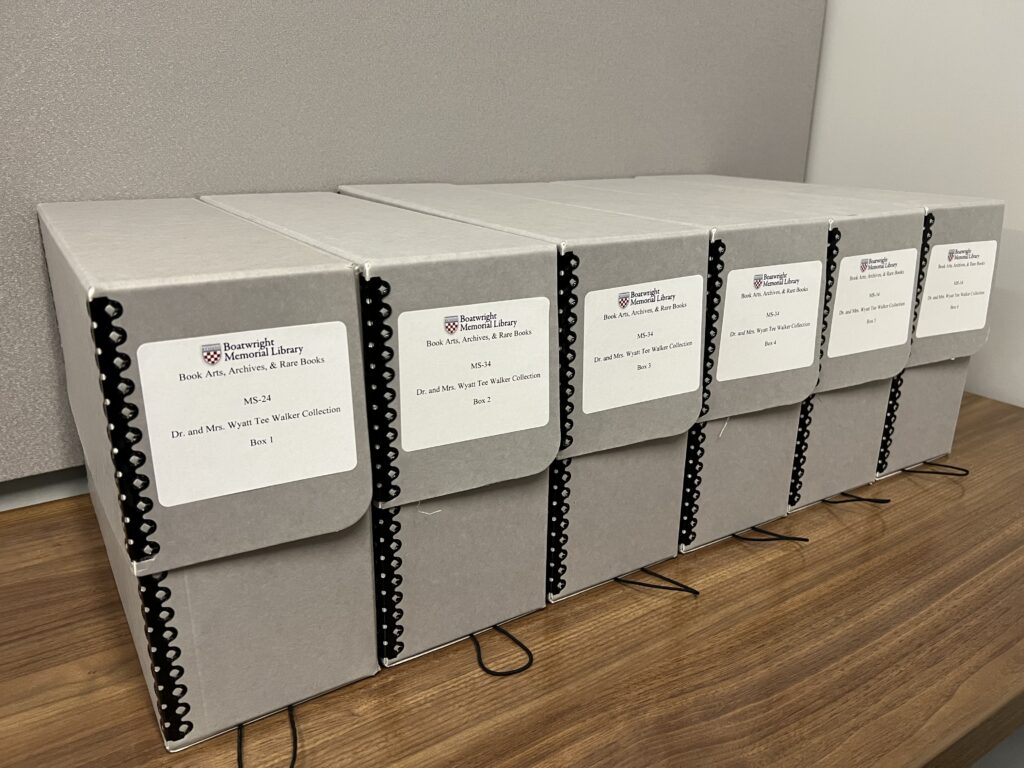
Six grey, legal size, archival boxes sitting in a row on a wooden desk. Each box bears a white label reading "Boatwright Memorial Library Book Arts, Archives, and Rare Books, MS-24 Dr. and Mrs. Wyatt Tee Walker Collection" followed by a box number.
The first six boxes of the Dr. and Mrs. Wyatt Tee Walker Collection.

Since Dr. and Mrs. Walker were already incredibly busy by 1964, this material is arranged into a number of series and subseries. Please note that these series and subseries may end up holding material from later (or much later) in Dr. and Mrs. Walkers’ lives, and that material is not yet available, meaning the series and subseries may not be fully open to research. You can view the finding aid, including a folder-level inventory of the material now open for research, in our online collection inventories.

If you have any questions or would like to request access to material, please email archives@richmond.edu and let us know what boxes or folders you would like to access. As we announced last week, we now have open hours four times a week and are happy to accommodate researchers who need to come in outside those hours by appointment.

Fall 2022 Open Hours

After several years of closure due to construction and the ongoing pandemic, we are finally able to reopen the newly renovated Rare Book Reading Room for regular open hours! The newly renovated space is part of the newly renovated floor B1 of Boatwright Memorial Library in the heart of the University of Richmond campus. The fall 2022 semester schedule for open hours is as follows:

Tuesdays: 12pm-2pm
Wednesdays: 12pm-3pm
Thursdays: 9am-12pm
Fridays: 11am-2pm

We can of course accommodate researchers by appointment outside of these hours, and we encourage all researchers to reach out before arriving so we can have material pulled and ready for your research. You can reach out directly by emailing us at archives@richmond.edu. Please also bear in mind that these hours are subject to change, especially in regards to University or federal holidays and staff availability.

When planning a research visit, you can find our rare books, including the Book Arts collection, in the library catalog and review our open archival collections in our online collection inventories. For questions on our holdings or assistance in locating material, please email us at archives@richmond.edu.

Witchcraft, Werewolves, & Vampires

Sepia toned image of black cat, old woman, and woman flying on broomstick in the countryside.
Image from the title page of Salem Witchcraft.

In addition to the various ghost-related books discussed in the previous post, the Galvin Rare Book Room is also home to a variety of materials pertaining to witchcraft. While the notion of “a witch” existed for hundreds of years, the witch trials in Europe and the British colonies in the Americas reached their peak between 1450 and 1750. Historians continue to study the many aspects of this phenomenon, exploring the varied cultural, social, religious, and political foundations that led to, and supported, the belief structures behind them. A quick search in the Boatwright Library catalog offers many options to read further on this topic.

The collections of materials on witchcraft in the Rare Book Room offer research opportunities into the topic, especially for students in Professor Sydney Watts’ History 199 course “Witches, Heretics, and Unbelievers: Orthodoxy & Heterodoxy in Western Europe, 1520-1800.” In this course, students focus on the basic elements of historical thinking and research by exploring the challenging concepts of the problem of truth and reality through the lens of witchcraft and heresy in early modern Europe. Examining primary and secondary sources are part of that research journey, and we always appreciate the opportunity to work with faculty, students, and staff on their research projects.

One of the primary texts defining the concept of a witch was the Malleus Maleficarum, or the Hammer of Witches, first published in 1486. Written by Catholic clergymen, the book functioned as a handbook for secular courts across Europe to assist in the identification, and eradication, of those deemed guilty of witchcraft.  Its three sections use natural philosophy and theology to prove the existence of evil, illustrate how witches recruit protégés, offers remedies and reversals for the spellbound, and provides legal guidelines on how to run a witch trial. The Galvin Rare Book Room copy is a facsimile edition featuring an English translation of the 1486 text. This edition totaled 1275 numbered copies, of which this item is number 537; it was a gift from St. Paul’s Episcopal Church.  (catalog link)

Earlier this year, we added a new work to the materials available to study the history of witchcraft, Del Congresso Notturnao delle lammie libri tre. (catalog link) Published in 1749, this item is a first edition printing highlighting arguments about practical magic and witchcraft coming from the Venetian Inquisition.  Arguing against the more traditional viewpoints, the author Girolamo Tartarotti, claims that rather than demonic possession and satanic pacts, the behaviors tagged as magic relate more to medicinal herbs and potions and the fantasies and visions those concoctions produced. Even further, he suggests that the public spectacles of witch burnings fueled additional charges and outbreaks, noting that implementing less harsh measures might reduce the allegations by giving them less public attention.  One notable chapter focuses specifically on werewolves, which Tartarotti believed were also the result of drug-induced visions.

Studying witchcraft in the American colonies focuses primarily on the trials held in Salem, Massachusetts between February 1692 and May 1693 when more than 200 people were accused and 19 executed by hanging after being found guilty of the charges. Several items in the collection relate directly to the happenings in Salem, including:

Cotton Mather, The Wonders of the Invisible World: being an account of the tryals of several witches lately executed in New-England; to which is added, A Farther Account of the tryals of the New-England Witches by Increase Mather. London: John Russell Smith, 1862 (catalog link)

Robert Calef, More Wonders of the Invisible World displayed: in Five Parts Boston: T. Bedlington, 1828.  (catalog link)

Salem Witchcraft: Comprising More Wonders of the invisible world, collected by Robert Calef; and Wonders of the Invisible World, by Cotton Mather; together with notes and explanations by Samuel P. Fowler. Boston: W. Veazie, 1865 (catalog link)

R.R. Hinman, The Blue Laws of New Haven Colony, usually called blue laws of Connecticut; Quaker Laws of Plymouth and Massachusetts; blue laws of New York, Maryland, Virginia, and South Carolina. First record of Connecticut; interesting extracts from Connecticut records; cases of Salem witchcraft; charges and banishment of Rev. Roger Williams, and other interesting and instructive antiquities. Hartford: Case, Tiffany, 1838 (catalog link)

Other materials in the Rare Book Room also offer information on the study of witchcraft, including Sir Walter Scott, Letters on Demonology and Witchcraft. New York: Harper & Brothers, 1841 (catalog link).  Witchcraft appears in other texts as well, including fictional works and in the artists’ books collection. Mary Johnson’s The Witch, published in 1914, is a novel set in 1600s England about a young English girl and a county physician who were part of the accused of sorcery and witchcraft (catalog link). Stories of witchcraft in colonial Virginia include James Bowyer’s The Witch of Jamestown, a story of colonial Virginia, published in 1890 (catalog link) in the Rare Book Room collection, while various depictions of the case of Grace Sherwood can be found in the circulating collection of the library. Even the historic children’s literature collection has two books on the topic: Tomie DePaola’s Strega Nona meets her match, published in 1993 (catalog link) and perhaps my personal favorite, Ib Spang Olsen’s The Marsh Crone’s Brew, translated by Virginia Allen Jensen in this 1960 version (catalog link).

Finally, one of the items in the artists’ books collections brings a contemporary experience to the study of witchcraft with the recently added work by Raeleen Kao, The Witch is Inside of Me. As indicated in the accompanying information sheet with the work, Kao describes it as a piece that “upends the nefariousness attributed to curiosity, sexuality, and disobedience in females and imbues the characters who raised me with power by embracing the corruptible, dual-faced nature within all of us.” (catalog link)

Oh, in case you were wondering when we’d get to the vampires in the title? There is indeed a work about vampires available.  The Galvin Rare Book Room is home to a first edition, printed in 1746, of Augustin Calmet’s Dissertations sur les apparitions des anges, des demons & des espirits. Et sut les revenans et vampires De Hongrie, de Moheme, de Moravie, & de Silesie. This comprehensive study contains nearly 500 pages of analysis about sorcery and witchcraft, demons and angels, and perhaps his most controversial comments about vampires.  As with some of the studies on witchcraft that attempt to reframe the conversation away from psychic or demonic elements and more towards physical aspects, Calmet’s opinions on vampires center on the effects of chemical substances in the soil on corpses. (catalog link)

Although under construction through Summer 2022, materials in the Galvin Rare Book Room are made available to UR faculty, staff, and students by appointment during this time.

Spiritualism & Ghost Stories

Cover image of Ghosts of Virginia, grey with white flowers.

Ghost stories have long been a part of American storytelling traditions.  During the 19th century, however, those stories took on new depth as the beliefs of Spiritualism took hold. Many historians date the beginnings of the Spiritualist movement to the 1848 occurrences in Hydesville, New York, where the young Fox sisters engaged in rapping games with unseen spirits. These three sisters raised the possibility of having not merely encounters but conversations with those who had passed away, including the exchange of information and knowledge between this world and the next.  Although talking to spirits was nothing new, their work, which included founding the first Spiritualist society, is credited as being the start of Spiritualism, a movement that would eventually expand worldwide and capture the imagination of millions, including Sir Arthur Conan Doyle.

Much like the time of the Scientific Revolution, where the triumph of reason was expected to destroy magical belief systems, many individuals at the end of the 19th century expected the rising industrialism and new science to quickly stamp out what appeared to be mere ghost stories. Such was not the case, as Spiritualists quickly adapted the tools of science to help further their cause, developing their own language of communication and tools during an era which saw tremendous advances in technology.  Historian Molly McGarry noted, “Speaking to the dead may have seemed no less strange than communicating across cables or capturing the living on film. Like freezing an image on a photographic plate, the Spiritualists’ ghost catching was a collapsing of time: the past perceived in the present for the future” (McGarry, 20). Spiritualism in the 19th century, then, was much less about the reality of life after death and communicating with the spirit world, as this belief predated the Spiritualist movement. Rather, it was the guiding rubric of science and technological development which shaped Spiritualism in this age, as practitioners “aimed to authenticate the immaterial presence of spirits of the dead through ‘objective,’ observable, and repeated experiences and through a rationalist discourse of ‘factual’ evidence” (Weinstein, 126).

While no ghosts (that we know of anyway), the Galvin Rare Book Room is home to a small collection of works about Spiritualism and ghost stories.   

Sir Arthur Conan Doyle, The New Revelation. New York: George H. Doran Co., 1918 Galvin Rare Book Room BF1272 .D7 1918  Gift of Mr. and Mrs. Verser Todd. (catalog link)

Sir Arthur Conan Doyle first became interested in Spiritualism around 1881 after attending a lecture. With further reading and study, Conan Doyle became a supporter and advocate of the movement. He was involved with organizations such as the British Society for Psychical Research and the Society for the Study of Supernormal Pictures, where he served as vice-president. In addition to his two-volume work on The History of Spiritualism, he also wrote about spirit photography (The Case for Spirit Photography) and about his own experiences with Spiritualism (The New Revolution, and The Wanderings of a Spiritualist). With the loss of his son during World War I, Conan Doyle continued his work and was considered an international expert in the field. Some credit his work in Spiritualism for one of his more famous quotes from The Case-Book of Sherlock Holmes, “When you have eliminated all which is impossible, then whatever remains, however improbable, must be the truth.”

Charles Beecher, Spiritual Manifestations Boston: Lee & Shepard; New York, C.T. Dillingham, 1879.  Galvin Rare Book Room BF1251 .B42 1879 (catalog link)

Charles Beecher was a noted American Congregationalist minister, composer, and author, something common among his siblings, including his sister Harriet Beecher Stowe and brother Henry Ward Beecher. His book, Spiritual Manifestations (1879) offers descriptions of his own experiences and encounters with Spiritualism.

Walter Cooper Dendy, The Philosophy of Mystery. New York: Harper & Brothers, 1845. Galvin Rare Book Room BF1031 .D5 1845 (catalog link)

Practicing surgeon as well as an author.  A collection of anecdotes about spectral apparitions, this work highlights dreams and spectral illusions in an attempt to explain or demystify the mysterious nature of fantastical things, and it is written in the style of a narrative dialogue.

Ray Bradbury, The Ghosts of Forever New York: Rizzoli, 1981.  Galvin Rare Book room PS3503 .R167 G47 1981 (catalog link)

Originally started as a script for a Smithsonian planetarium show that was never produced, The Ghosts of Forever combines the wordsmithing of Bradbury, in poems and a short story, with illustrations by Aldo Sessa into a delightful space-age adventure as only Bradbury’s mind could conjure up.

Amélie Rives (Princess Troubetzkoy). The Ghost Garden: A Novel. New York: Grosset & Dunlap, 1918.  Galvin Rare Book Room PS3092 .G47 1918 (catalog link)

Best known for her book The Quick and the Dead, Rives’ work is set in colonial Virginia and tells the tale of lovelorn struggle between the living and the dead. Richmond-born, Rives was a prolific writer who was especially interested in educational reform and women’s suffrage. Also of note is the study of Rives’ life written by prominent UR faculty emeritus W.D. Taylor in 1973.

Marguerite du Pont Lee, Virginia Ghosts & Others. Richmond: William Byrd Press, 1932. Inscribed “To my ghosts” by the author to the Marion Garnett Ryland Virginiana Collection at the University of Richmond. Galvin Rare Book room F227 .L48 1932 (catalog link)

Printed in Richmond in 1932, Virginia Ghosts contains more than 100 ghost stories from around the commonwealth, many with pictures of the haunted sites and homesteads. Stories from Richmond include ones near Englewood and Westover as well as the governor’s mansion.  Not surprisingly, the author was a serious student of psychic phenomena of Richmond and beyond as well as being a proponent of women’s rights.

Works Cited

McGarry, Molly. Ghosts of Futures Past: Spiritualism and the Cultural Practices of Nineteenth-Century America. Berkeley: University of California Press, 2008.

Weinstein, Sheri. “Technologies of Vision: Spiritualism and Science in Nineteenth-Century America,” in Jeffery Andrew Weinstock, ed. Spectral America: Phantoms and the National Imagination, 124-140. Madison: University of Wisconsin Press, 2004.

Early Views of Richmond

Two recent additions to the Galvin Rare Book Room collection offer a glimpse of life in Richmond and surrounding areas during the late 1700s.  Travels in North-America, in the years 1780, 1781, and 1782 by the Marquis de Chastellux (1787) and A Tour in the United States of America… written by J.F.D. Smyth (1784) describe journeys around the country, and both men visited Richmond during their travels.  Both authors offer descriptions of the Richmond area and especially travel on the James River; Smyth also described an excursion to Westham. These two works join others in the collection that offer historical insights into travel, commerce, tobacco, and other cultural elements of the region.title page from Chastellux

Currently open to UR students, staff, and faculty, Rare Books & Special Collections in Boatwright Library is home to a growing collection of materials covering a wide variety of topics across the disciplines.  The department preserves and provides access to a significant collection of books and printed materials dating between 1472 and 2019 and archival collections pertaining to the Civil War, World War I and II, UR history, civil rights, maritime adventures, and other 19th and 20th century events.  You can also explore a variety of artists’ books in the collection. Use OneSearch to explore holdings in the collection, and if you are interested in incorporating these materials in your classes or for an assignment, we’re happy to work with you by appointment.

Chastellux, Francois Jean, marquis de. Travels in North America in the years 1780, 1781, and 1782. London: Printed for G.G.J.&J. Robinson, Pater-noster Row, 1787. 2 volumes (Catalog record)

Stuart, John Ferdinand Smyth. A Tour in the United States of America: containing an account of the present situation of that country, the population, agriculture, commerce, customs, and manners of the inhabitants, anecdotes of several members of Congress and general officers in the American army, and many other interesting and singular occurences[sic]: with a description of the Indian nations, the general face of the country, mountains, forests, rivers, and the most beautiful grand, and picturesque views throughout that vast continent: likewise improvements in husbandry that may be adopted with great advantage by Europe. Dublin: Printed by G. Perrin for Messrs. Price, Montcrieffe, Walker, Exshaw, Wilson, Burnet, Jenkin, White, Burton, Byrne, Whitestone, Colbert, Cash, Heery, and Marchbank, 1784. (Catalog record)

Under Construction (again)

Last week’s Library Minute by University Librarian Kevin Butterfield highlighted some of the exciting new changes coming to Boatwright Memorial Library and specifically to the B1 level as it goes under construction for the 2021-22 academic year. The Rare Books, Special Collections & Book Arts team is very much looking forward to moving into new spaces next summer, areas that will allow for greater interaction and activities with students, faculty, and staff as well as increased opportunities for collaboration, especially with University Museums.

Even though Level B1 is under construction, we are definitely not closed and are already actively engaged in fall instruction and outreach. Work with students and faculty in classes, on specific assignments, and on individual projects and research requests continues as we creatively work around some temporary spaces. If you are considering adding instruction sessions for book arts, rare books, or archives, please reach out to any of the department’s staff or use the links below.  If we can be of assistance with a research or reference request, we are happy to accommodate those requests as well. There are also lots of materials available to explore through the library’s Digital Collections.

We’re looking forward to new spaces in the coming year but know that throughout the construction process during this academic year, we are here to assist your research, reference, and class projects.

Book Arts Instruction Request

Rare Books & Special Collections Instruction Request

Rare Books & Special Collections Materials Reference Request