Ordinarily, one associates ‘November boughs’ with flown birds, vanished scents, tattered foliage, skies of steel…everything is ready for the long, long sleep…. Is this true of Walt Whitman’s book? In a sense; it is a preparation for the long sleep… Sap at seventy is seldom so affluent as it is in this striking volume, binding up the life-long thoughts of a revolutionist in verse, an evolutionist in belief…. On the whole, all these ‘boughs’ together made a very rich bouquet, tied at every twig with a love-knot for the reader and full of the unction and eloquence of a most sweet personality. ~ W. Harrison (1)
In writing that review for The Critic in mid-January 1889, shortly after the book’s publication, Harrison highlighted a significant aspect by noting that Whitman would very shortly turn seventy years old and was, in the parlance of his works, writing late in the season of his life. His first new book in almost seven years, November Boughs contains 140 pages of Whitman’s prose and poetry, a coming together of new pieces and works previously published elsewhere. What the reader encounters in this volume is Whitman in retrospective contemplation, explaining what he thought he had been doing all along.
The book opens with a lengthy preface, “A Backward Glance O’er Travel’d Roads,” in which Whitman looks back at Leaves of Grass, acknowledging that it had not found the acceptance he had hoped for in his lifetime. Whitman noted, “That I have not gain’d the acceptance of my own time,…. That from a worldly and business point of view “Leaves of Grass” has been worse than a failure.” However, he reflected, “I had my choice when I commenc’d…. I have had my say entirely my own way, and put it unerringly on record—the value thereof to be decided by time.” (2) This reflective narrative set the tone for much of the additional writings included.
Following the preface is a series of about sixty short poems, grouped under the heading “Sands at Seventy.” Within the usual themes of nature and places, readers also find meditations on aging, mortality, memory, and perhaps final farewells. Whitman later added these poems to Leaves of Grass as an annex, and the preface, “A Backward Glance,” became that book’s closing essay.
The rest of the book is prose Whitman had already printed or published elsewhere. The prose pieces cover wide-ranging topics including the writings of Shakespeare, Tennyson, and Robert Burns, memories of New York and travel to New Orleans, and an essay on “Slang in America.” He also writes of his work tending to wounded soldiers during the Civil War and about Abraham Lincoln. Other essays focus on religion, including “The Bible as Poetry,” and an essay on a Quaker preacher, Elias Hicks, whom Whitman heard preach when he was a child.
Whitman’s health prevented him from managing the practical printing of this work as he did for other works like his 1855 Leaves of Grass. Living in Camden, New Jersey, at this time, Whitman relied on a friend named Horace Traubel to ferry the work to and from the printer. David McKay of Philadelphia published November Boughs in October 1888, and he also bought the rights to print additional copies between 1888 and 1890. Traubel also served as Whitman’s literary executor, and his work with Whitman was eventually published as a nine-volume detailed collection, With Walt Whitman in Camden, including what amounts to a daily log of conversations, visitors, and correspondence.
Bibliographers have identified three distinct printings of the first edition sheets for November Boughs. The first printing in late 1888 included 1,000 copies, and, like other works of Whitman’s, the earliest printings can be tracked via typographical errors. Most notably, early versions contain an error on page 6, where the French phrase “en mêlée” was misprinted as “m lée” and on page 11 the word “least” which should have been “last.” It also included a printed photograph of an ageing Whitman across from the title page. Later printings in 1889 and 1891 have those errors corrected, and the 1891 printing did not contain the photograph of Whitman. In addition to the typographical differences, the bindings also changed from printing to printing. Noted Whitman bibliographer Joel Myerson cataloged the differences in the bindings among the various printings to help identify which volume an owner might have. (3)
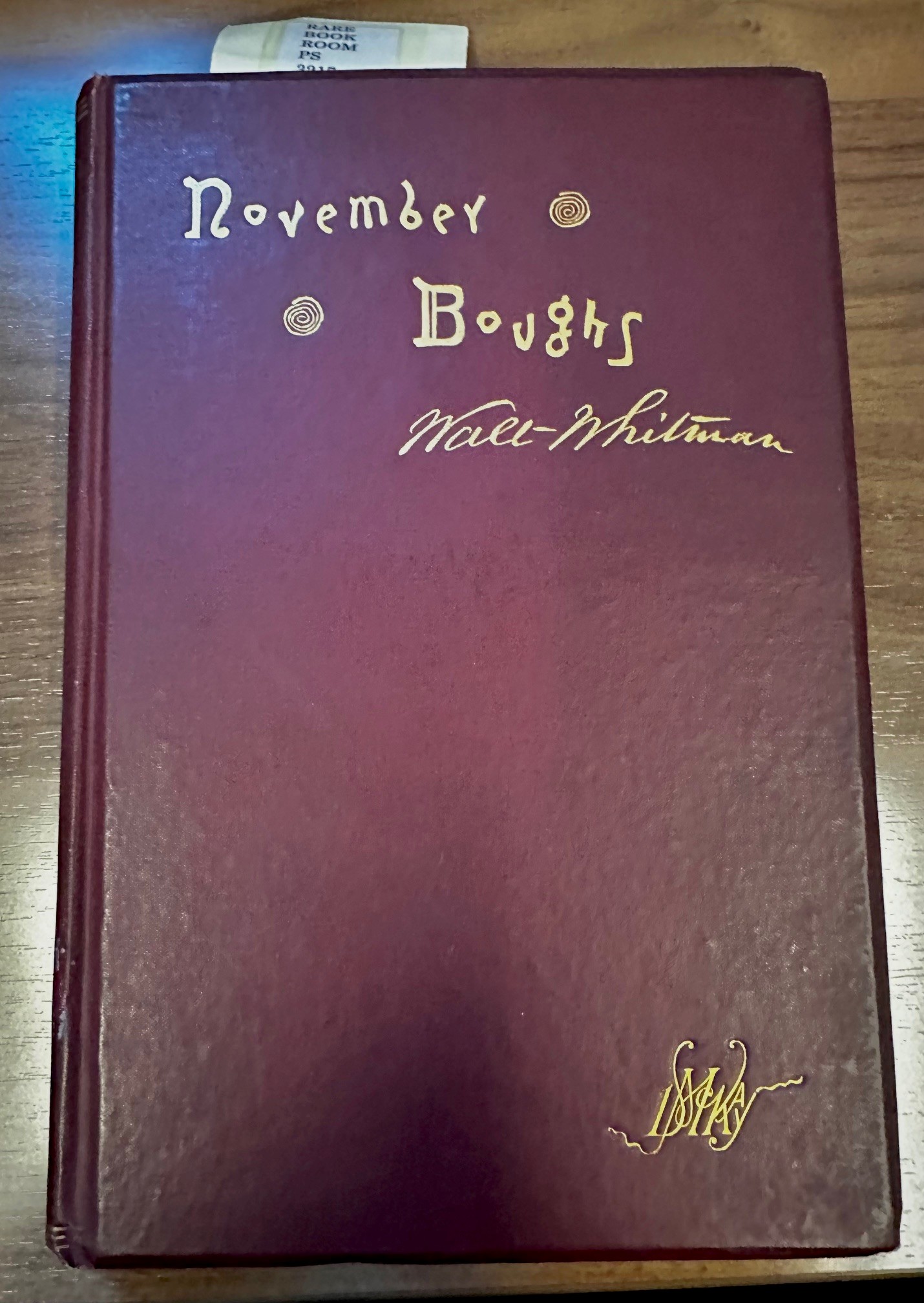
The Galvin Rare Book Room collection holds a first edition of November Boughs, showing an 1888 publication date. The typographical errors listed above are present in this volume, indicating it was printed prior to any corrections done for later printings. Using Myerson’s criteria, this volume conforms to Binding E, as it was bound in maroon cloth over beveled boards; the front cover has a facsimile of Whitman’s signature, the publisher’s monogram, and circular designs stamped in gilt. Additionally, the spine also features gilt lettering, and the specific triple ruled lines at the top and bottom of the spine that distinguish Binding E from other variations. This volume contains an ex libris bookplate noting “This book belongeth to August Henry Henke,” and it was a gift of Charles E. Feinberg in memory Roger Millhiser. Interestingly, the Library of Congress holds a collection titled “Walt Whitman Papers in the Charles E. Feinberg Collection,” which contains a series on Albert Aylward personal papers that includes correspondence, newspaper clippings, photography, and miscellany. (4)
If you would like to explore Whitman works in our collection, including a first-edition Leaves of Grass, please plan a visit during our Fall 2026 reading room open hours, Mondays through Thursdays from noon to 4:00pm, or email archives@richmond.edu to make an appointment.
- W. Harrison, “Walt Whitman’s November Boughs.” The Walt Whitman Archive. Gen. ed. Matt Cohen, Ed Folsom, and Kenneth M. Price. Accessed 16 November 2026. https://whitmanarchive.org/item/anc.00123
- Walt Whitman, November Boughs, Philadelphia: David McKay, 1888, pp. 5-6.
- Joel Myerson, Walt Whitman: A Descriptive Bibliography. University of Pittsburgh Press, 1993.
- MSS18630 Walt Whitman Papers in the Charles E. Feinberg Collection, Library of Congress Manuscript Division https://findingaids.loc.gov/repositories/19/resources/2597